
If you scan a QR code to pay Rs 500 for groceries, nothing changes for you. But if you pay Rs 5,000 for a new phone case or a big shopping bill through UPI, a new rule kicks in behind the scenes from October 15, 2026. This piece breaks down exactly what that rule is, in plain language.
Quick Summary
| Question | Answer |
| What is new | A 0.4% MDR charge on UPI merchant payments above Rs 2,000 |
| Who pays it | The merchant, not the customer |
| When it starts | October 15, 2026 |
| What stays free | All UPI and RuPay debit payments up to Rs 2,000 |
| Maximum fee | Capped at Rs 300 for transactions of Rs 75,000 or more |
| Who decided this | NPCI’s UPI and Services Steering Committee |
| Legal basis | Amendment to Section 10A of the Payment and Settlement Systems Act |
What Is MDR in Simple Words
MDR stands for Merchant Discount Rate. It is a small fee a merchant pays every time a customer pays them through a digital mode like UPI, a debit card, or a credit card. Think of it as a service charge for using the payment network.
Since 2020, MDR on UPI and RuPay debit card transactions was zero. The government wanted to push digital payments, so it removed this fee completely. That is why paying through UPI has always felt free, both for customers and merchants.
What Changed and Why
This monsoon session, Parliament amended Section 10A of the Payment and Settlement Systems Act. This reopened a legal path for MDR on electronic payments, something that was blocked since 2020.
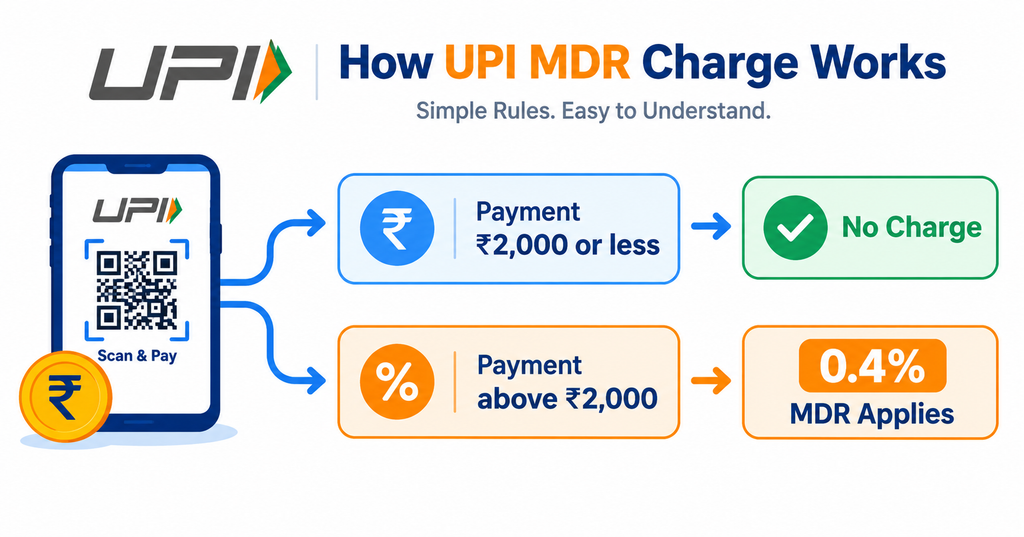
On September 14, the government issued a notification. It confirmed that UPI and RuPay debit payments up to Rs 2,000 will stay completely free, for both individuals and merchants. No bank or payment app can charge on these, in any form.
For payments above Rs 2,000, NPCI stepped in with the actual number. A 0.4% MDR now applies on person-to-merchant UPI payments above that limit. This fee is capped at Rs 300 for transactions worth Rs 75,000 or more, so it does not keep rising endlessly on very large payments.
Step-by-Step: How the New Rule Works
- A customer pays a merchant through UPI.
- If the amount is Rs 2,000 or less, there is no charge at all. Nothing changes here.
- If the amount is more than Rs 2,000, a 0.4% MDR applies on that transaction.
- This 0.4% is deducted from the merchant’s settlement, not added on top of what the customer pays.
- If the transaction value reaches Rs 75,000, the fee stays capped at Rs 300, even though 0.4% of that amount would be higher.
- Person-to-person transfers, like sending money to a friend or family member, stay free at every amount.
A Real Example
Say a customer buys a jacket worth Rs 4,000 from a small clothing store and pays through UPI.
- MDR applies since the amount is above Rs 2,000.
- 0.4% of Rs 4,000 works out to Rs 16.
- The store receives Rs 3,984 in settlement, and Rs 16 goes toward the MDR.
- The customer still pays exactly Rs 4,000. Nothing extra is deducted from their side.
Now take a bigger example. A customer buys furniture worth Rs 90,000 through UPI.
- 0.4% of Rs 90,000 would normally be Rs 360.
- Since the transaction crosses Rs 75,000, the fee is capped at Rs 300 instead.
- The store receives Rs 89,700 in settlement.
Who This Rule Actually Affects
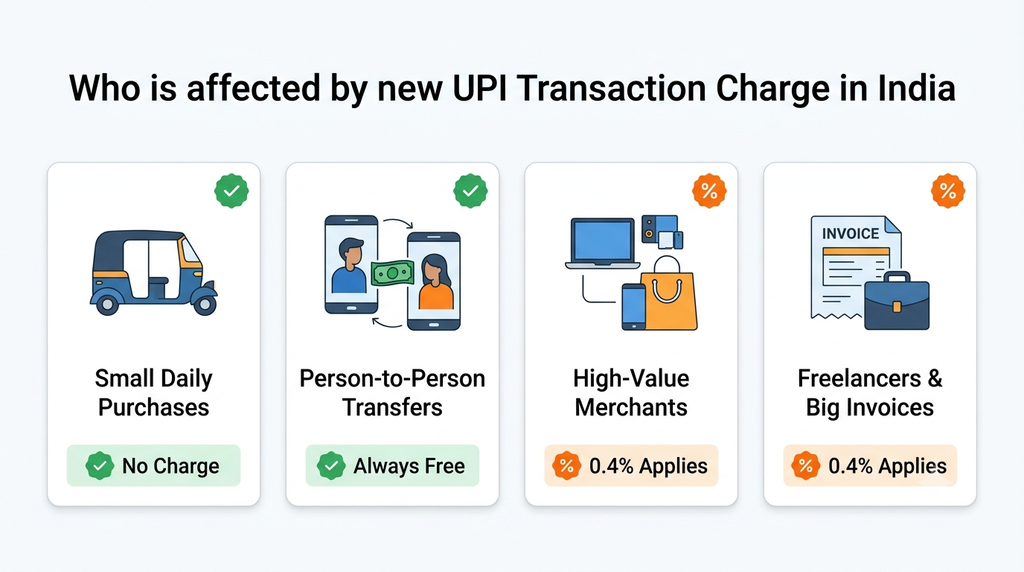
Small daily transactions: Tea stalls, autos, small grocery runs, and most person-to-person transfers are unaffected. These usually stay well under Rs 2,000.
Merchants with high-value orders: Electronics stores, furniture shops, larger retailers, and e-commerce platforms will see this charge more often, since their average order value is higher.
Service providers with big invoices: Freelancers, consultants, or contractors billing clients above Rs 2,000 through UPI will now see a small deduction in what they receive.
Costly Mistakes to Avoid
- Do not assume the customer is being charged extra. The MDR is deducted from the merchant’s side, not added to the bill, under the current rule.
- Do not confuse this with a UPI transaction limit. There is no cap on how much you can pay through UPI. The Rs 2,000 line here only decides whether MDR applies.
- Business owners should not ignore checking their payment settlement reports after October 15. The 0.4% deduction will show up there, and reconciling it early avoids confusion later.
- Do not assume person-to-person transfers are affected. They are not, regardless of amount.
FAQ
Q: Does this new rule apply to all UPI payments?
No. It applies only to person-to-merchant UPI payments above Rs 2,000. Person-to-person transfers stay free at every value.
Q: Will my UPI app show a separate charge when I pay?
No. The MDR is deducted from the merchant’s settlement amount, not shown as a separate charge to the customer.
Q: What is the MDR rate under the new rule?
0.4% on UPI merchant payments above Rs 2,000, capped at Rs 300 for transactions of Rs 75,000 or above.
Q: From when does this rule apply?
October 15, 2026.
Q: Can banks or apps charge extra fees beyond this MDR?
The current framework does not allow additional direct or indirect charges on payments up to Rs 2,000. For amounts above that, the MDR is the only sanctioned charge under this rule.
Q: Why did the government bring back MDR after removing it in 2020?
To create a sustainable funding model for UPI’s infrastructure, cybersecurity, and customer service costs, since the zero-MDR system relied heavily on a government incentive scheme that industry players said fell short of actual costs. iss blog ko check karlo and ager kuch kami lage toh imporve kar dena