
Kshitij Polyline is not a name most investors know. But on X, it’s suddenly everywhere. The micro-cap stock has been hitting upper circuits for days, and the company just announced a ₹14 crore debt repayment, an NCLT acquisition, and a recycling plant expansion.
Is this a genuine turnaround — or just another small-cap hype?
Let me break it down.
What Is Kshitij Polyline?
Kshitij Polyline Limited is a Mumbai-based company that manufactures and exports stationery products, lamination equipment, and smart ID card products. Think office files, binding machines, ID card accessories, and plastic sheets.
The company was founded in 1998 and has 84 employees. It exports to countries like Uganda, Sri Lanka, South Africa, Nepal, and Dubai.
On the NSE, the stock trades under the symbol KSHITIJPOL. It’s a micro-cap — the market cap is around ₹72-75 crore.
What’s Driving the Upper Circuits?
The stock has been hitting upper circuits — meaning it’s getting locked at the maximum allowed daily gain because there are more buyers than sellers.
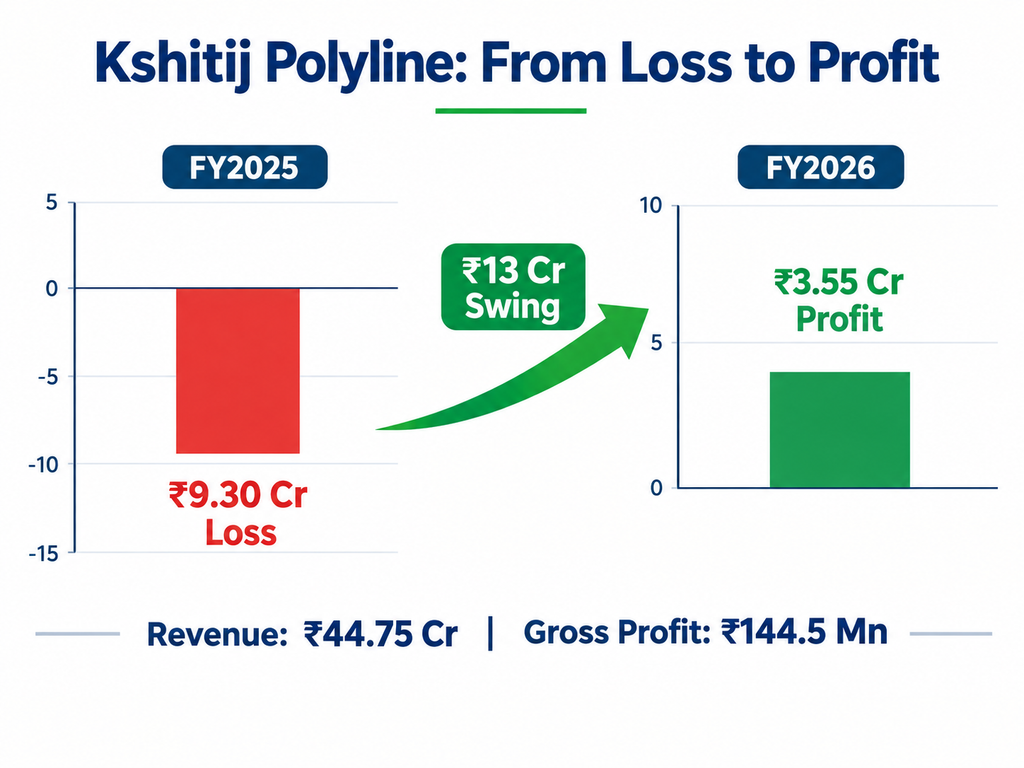
The recent surge has been fueled by three major announcements:
1. ₹14-15 Crore Debt Repayment
The company has successfully completed full and final payment towards the acquisition of Omkar Speciality Chemicals Limited, in accordance with a Resolution Plan approved by the NCLT Mumbai Bench.
This is a big deal. The company infused ₹2,665 lakhs (₹4.75 crore as equity and ₹21.9 crore as loans) to acquire Omkar Speciality Chemicals. The acquisition is expected to strengthen Kshitij Polyline’s presence in the specialty chemicals segment.
2. NCLT Acquisition Complete
The acquisition of Omkar Speciality Chemicals means Kshitij Polyline is expanding beyond stationery and plastics into specialty chemicals. Omkar has manufacturing units in MIDC, Badlapur, and Lote Parshuram Industrial Area, Chiplun, Maharashtra.
The company expects this acquisition to become a “major growth driver and strategic pillar” for future expansion.
3. Recycling Plant Expansion
The company is also expanding into plastic recycling, with a new recycling plant land acquired and machinery being commissioned.
The Turnaround Story: From Loss to Profit
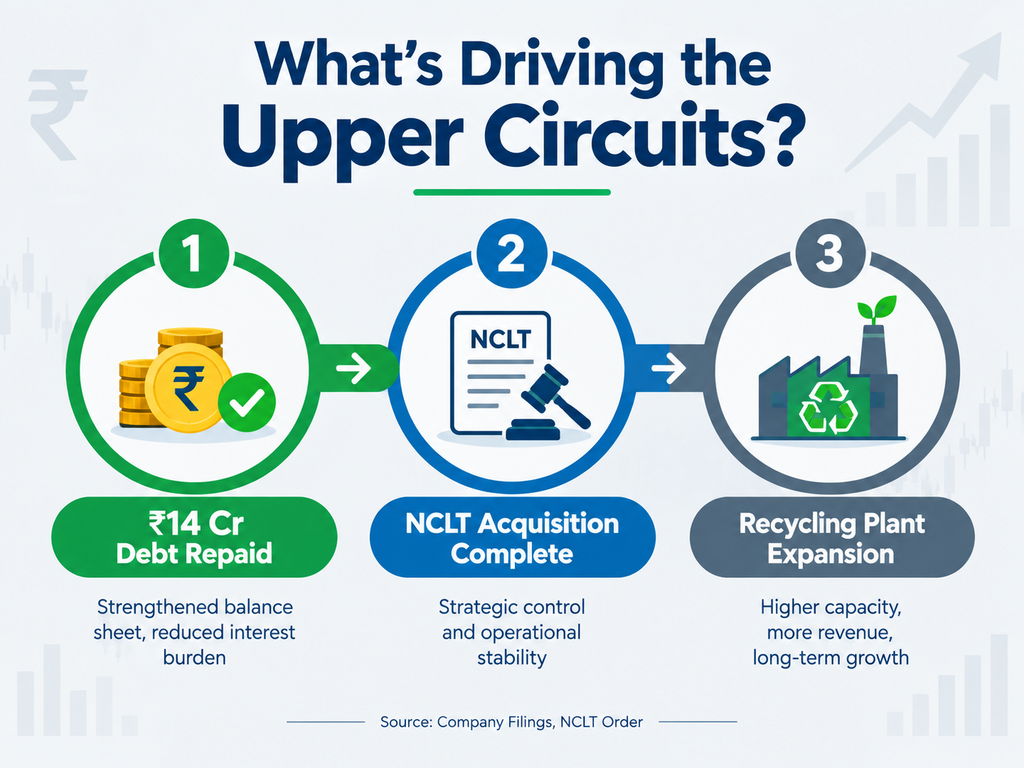
In FY2025, Kshitij Polyline reported a loss of ₹9.30 crore. In FY2026, the company turned it around with a profit of ₹3.55 crore — a swing of nearly ₹13 crore.
Revenue for FY2026 was ₹447.51 million (₹44.75 crore), up 6.79% from the previous year. But the real improvement came from gross profit, which jumped from ₹20.82 million to ₹144.5 million — a massive increase in margins.
In the most recent quarter (Q1 FY27), the company reported revenue of ₹14.95 crore, up 10.82% QoQ and 57.58% YoY.
But Here’s the Catch: Speculative vs. Conviction Buying
Not everything is rosy.
When a stock hits an upper circuit, it’s easy to assume that “smart money” is buying. But the delivery volume tells a different story.
On September 1, Kshitij Polyline hit its upper circuit of 4.9%, closing at ₹3.00. The stock had unfilled buy orders — meaning there were more buyers than the price band could accommodate.
But here’s the problem: delivery volume declined by nearly 26% compared to the 5-day average. This suggests that the surge may be speculative rather than driven by strong long-term conviction.
When delivery volume drops on a circuit day, it often means that traders are buying for short-term gains, not investors holding for the long term. That’s a warning sign.
The Liquidity Problem
Kshitij Polyline is a micro-cap stock. That means liquidity is thin.
Based on 2% of the 5-day average traded value, the stock is liquid enough for a trade size of just ₹0.01 crore. For context, that’s ₹1 lakh.
For retail investors, this creates a problem: entering or exiting a sizable position could be difficult without impacting the price. And if the stock hits a lower circuit, you might not be able to sell at all.
This is the dark side of circuit stocks. When the music stops, the door is too small for everyone to exit.
What Do the Moving Averages Say?
Technically, Kshitij Polyline closed above its 20-day moving average but remains below its 5-day, 50-day, 100-day, and 200-day moving averages.
This indicates a tentative breakout at the short-term level, but a lack of confirmation from longer-term trend indicators. The stock’s inability to clear the 5-day moving average suggests that the rally may be nascent or vulnerable to pullbacks.
The Verdict: Turnaround Story or Speculative Hype?
Kshitij Polyline has genuinely improved its fundamentals. The debt repayment, the NCLT acquisition, and the recycling expansion are real developments. The company has swung from a ₹9 crore loss to a ₹3.5 crore profit.
But the delivery volume decline and liquidity constraints are red flags. The upper circuits are impressive on the surface, but the ability to transact meaningful volumes without slippage is severely constrained.
For investors, the question is simple: Are you buying because of the fundamentals, or because of the FOMO?
If it’s the latter, remember that circuits work both ways. What goes up can come down just as fast.
Disclaimer: This blog is for informational purposes only. It is not investment advice. Investing in the stock market involves risks. Please consult your financial advisor before making any investment decisions.