
For most developers around the world, trying a new AI model means checking the price, running a few tests, and deciding if it fits the budget. However, for some users this time, the calculation has become more complicated than it looks.
Elon Musk’s SpaceXAI launched Grok 4.7 on September 21, and the headlines screamed one thing: 80% cheaper than rivals. The API pricing looked unbelievable — $2 per million input tokens, $6 per million output tokens. Compared to Claude Fable 5.1 and GPT-6 Astra, which charge $50 per million output tokens, this looked like a steal.
But here’s the catch. The price on the sticker is not the price you pay.
The Price Shock: What Elon Musk Announced
Grok 4.7’s pricing is aggressive. No doubt about it.
- Input: $2 per million tokens
- Output: $6 per million tokens
- Cache Read: $0.5 per million tokens
Compare that to its rivals:
| Model | Output Price (per million tokens) |
|---|---|
| Grok 4.7 | $6 |
| Claude Fable 5.1 | $50 |
| GPT-6 Astra | $50 |
That’s an 80% price cut. Elon Musk didn’t just undercut the competition — he slashed prices by eight times.
The model also comes with a 500,000 token context window, which means it can process long documents and codebases in one go. It has 2.1 trillion parameters, 40% larger than Grok 4.6.
For developers everywhere, this looked like the deal of the year.
But then the benchmarks came out.
The Benchmark Problem: “Disappointing” Scores
Grok 4.7’s benchmark scores told a different story.
- Intelligence Index Score: 46 points
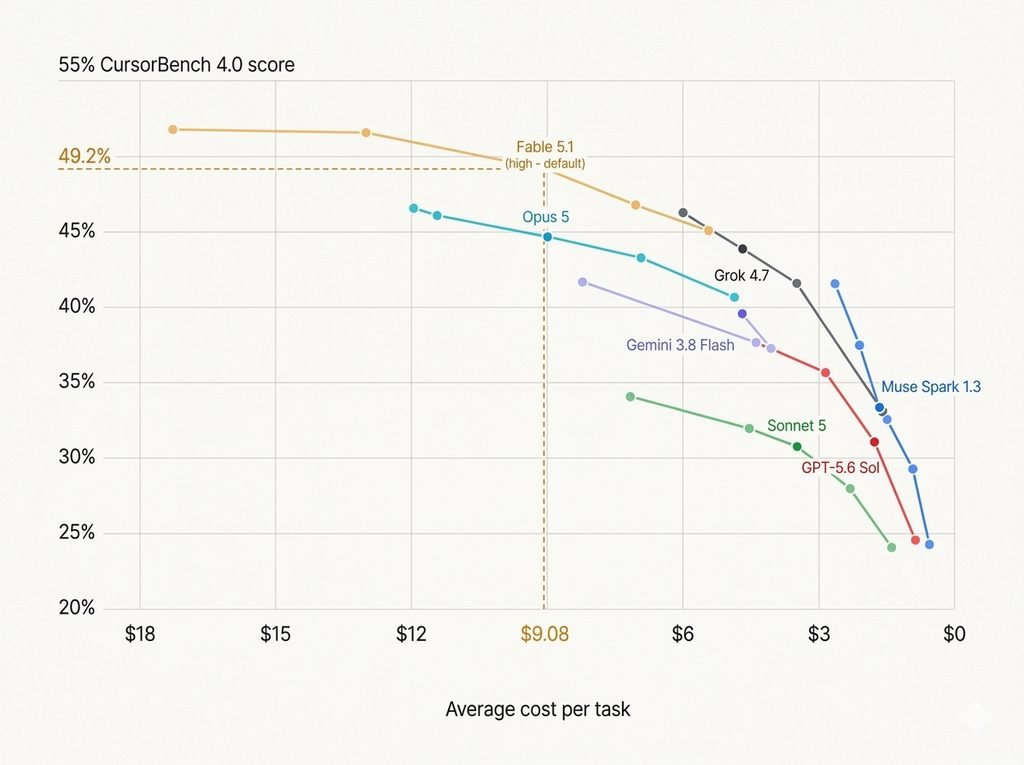
- CursorBench 4.0 (Coding Task): 46.3%
That’s not bad. But it’s not revolutionary either.
Here’s how it compares:
| Benchmark | Grok 4.7 | Grok 4.6 | GPT-6 Astra | Claude Fable 5.1 |
|---|---|---|---|---|
| CursorBench 4.0 | 46.3% | 40.4% | 41.7% | 51.8% |
| DeepSWE v1.1 | 71.0% | 65.2% | 72.7% | 70.0% |
| Terminal-Bench 4.0 | 38.0% | 20.3% | 37.3% | 57.9% |
Grok 4.7 improved over Grok 4.6. But it’s still behind Claude Fable 5.1 and GPT-6 Astra on most benchmarks.
Several tech media reports called the scores “disappointing.” Elon Musk himself admitted that Grok 4.7 is on par with Claude Opus 5.0, but below Opus 5.1.
So the model is cheaper. But is it better? Not really.
The Hidden Cost: Why You Might Pay 3x More
Here’s where the real story begins.
Grok 4.7 is verbose. That’s the technical term. In simple language: it talks too much.
This means the model spends a lot more words — tokens — to generate responses.
- Grok 4.7: 81,000 tokens for one task
- Grok 4.6: 36,000 tokens for the same task
- GPT-5.6: Just 27,000 tokens for the same task
So even though Grok 4.7’s tokens are cheaper, it spends 2-3x more tokens to do the same work.
Here’s an example:
If GPT-6 Astra takes 27,000 tokens for a task at $6 per million tokens, that’s **$0.162**.
If Grok 4.7 takes 81,000 tokens for the same task at $6 per million tokens, that’s **$0.486**.
That’s 3x more expensive — even though the sticker price looked cheaper.
For developers paying in dollars, this is a big deal. The “80% cheaper” claim only works if you use the same number of tokens. But Grok 4.7 doesn’t.
What Developers Are Saying
The reaction from the global developer community has been mixed.
“This is classic Elon Musk marketing,” said Rohan Mehta, a Bengaluru-based AI engineer. “The price looks great until you actually run it. Then you realize you’re burning through tokens three times faster than with GPT or Claude. For a startup like ours, that’s the difference between profit and loss.”
Another developer, Priya Nair from Hyderabad, said she tested Grok 4.7 for a week. “It’s fast, and the context window is great. But the verbosity is a problem. We had to write custom prompts just to get it to stop rambling. That’s extra work we didn’t sign up for.”
Not everyone is unhappy though.
“It’s still cheaper for simple tasks,” said Arjun Sharma, a freelance developer in Pune. “If your prompts are short and you don’t need precision, Grok 4.7 works fine. But for complex coding or long-form analysis, you’re better off with Claude or GPT.”
Elon Musk’s Strategy: The Price War
There’s a bigger story here.
Nine days before Grok 4.7’s launch, Anthropic CEO Dario Amodei published an essay titled “We Must Slow Down Frontier AI.” Elon Musk replied on X, agreeing with him.
Nine days later, Elon Musk launched Grok 4.7 and slashed prices so aggressively that the market was shaken.
So what happened?
Elon Musk didn’t slow down. He changed the battlefield. Instead of competing on intelligence — where Grok is still behind — he competed on price.
It’s a classic strategy. If you can’t beat them on quality, beat them on cost.
But for developers, the calculation is more complicated. A cheaper model that uses 3x more tokens isn’t actually cheaper. And a model that’s “good enough” isn’t always good enough.
Safety: The One Area Where Grok 4.7 Wins
There’s one area where Grok 4.7 genuinely improved: safety.
- Standard Jailbreak Rate: Dropped from 0.73% to 0.01%
- Biosafety Score: 62.4% (among top performers on LatchBio benchmark)
- HackerBench v0.3: Only 3.3% risky prompts allowed through
According to SpaceXAI, Grok 4.7 has a new safeguard stack that’s better at both jailbreak resistance and dangerous task refusal. The company has also started giving cybersecurity partners invite-only access to Grok 4.7’s red-team capabilities.
For enterprises worried about AI safety, this is a genuine improvement.
The Global Price Arbitrage: What It Means for Different Markets
The pricing gap between Grok 4.7 and its rivals isn’t just a US story. It’s a global one.
In India, developers pay in dollars for most AI APIs. A 3x token usage difference hits harder when the rupee is weak.
In Europe, where data sovereignty rules are strict, Grok 4.7’s US-based infrastructure might be a dealbreaker — no matter how cheap it is.
In Southeast Asia, where startups are price-sensitive, Grok 4.7’s low sticker price is attractive. But the hidden token cost could eat into margins.
In the US, where most AI companies are based, the pricing war is felt most directly. Startups that were locked into GPT or Claude are now re-evaluating their options.
The lesson is the same everywhere: Don’t trust the sticker price. Trust your bill.
What Should Developers Do?
If you’re a developer trying to decide whether to use Grok 4.7, here’s a simple framework:
If you’re building simple applications:
Grok 4.7 is worth trying. The price is low, and for simple tasks, the verbosity doesn’t matter much.
If you’re building complex applications:
Test it carefully. Run your actual workloads and measure token usage. Don’t trust the sticker price. Trust your bill.
If you need the best performance:
Claude Fable 5.1 and GPT-6 Astra are still ahead. If performance matters more than price, stick with them.
If you’re on a tight budget:
Grok 4.7 is the cheapest frontier model available. Just be prepared for higher token usage.
Conclusion: The Price Is Real, The Savings Are Not
Elon Musk’s Grok 4.7 is a genuine price revolution. At $2/$6, it’s the cheapest frontier AI model on the market.
But for developers, the savings are not as simple as they look.
- The model is verbose — it uses more tokens
- The benchmarks are disappointing — it’s not the best
- The actual cost is higher — 3x more than advertised
Grok 4.7’s “bang” is in its price, not its performance. Elon Musk has won the pricing war. But the intelligence war is far from over.
For developers everywhere, the lesson is simple: Don’t trust the sticker price. Trust your bill.
Disclaimer: This blog is for informational purposes only. It is not investment advice or a recommendation to buy or use any AI model. Data is based on information available as of September 21, 2026.