

A historic event is unfolding in India’s telecom market. Reliance Jio, which transformed the entire industry landscape with its launch in 2016, is now preparing to enter the capital market through its IPO. According to reports, the IPO could be based on a valuation of approximately $108 billion (around ₹9 lakh crore), which would make it not only India’s largest IPO but also one of the biggest in the world. However, there is a major challenge on the road to realizing this dream — growing rivalry with Elon Musk’s Starlink. This competition is in the satellite internet sector, where Musk has already established a strong global presence, and his entry into India could prove to be a new test for Jio.
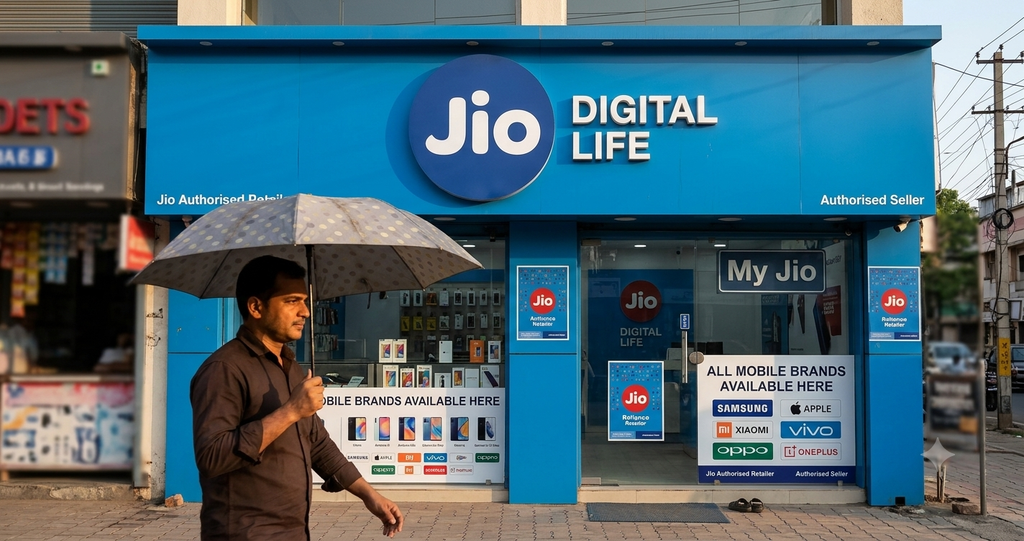
Jio’s Journey and IPO Preparations
Reliance Jio’s story is one of the most interesting chapters in Indian business history. When Jio entered the market in 2016 with free data and free voice calls, many competitors were pushed out of the market. Today, Jio has more than 450 million subscribers and has become India’s largest telecom company. The company has also shown speed in 5G rollout and has expanded its reach in domestic broadband (Jio Fiber) as well as enterprise services.
Now, as Jio prepares to launch its IPO, investors are watching closely to see at what valuation the company will enter the market. If the $108 billion figure proves true, it will be a major milestone for the Indian capital market. The funds raised through this IPO could be used by the company for its 5G and 6G preparations, data center expansion, AI-based services, and debt reduction.
But the question is: will the market accept this massive valuation? The Indian stock market has seen a flood of IPOs in recent years, and investors have become more cautious. Many large IPOs have not been able to sustain their listing gains. In such a scenario, Jio will have to present its financial health, customer growth possibilities, and future plans to the market in a very solid manner.

Musk’s Starlink and the Clash in the Indian Market
Elon Musk’s Starlink is providing satellite internet services around the world. There has been long-standing discussion about Starlink’s entry into India. Although India’s satellite communication rules and licensing process have been quite complex, the government has given some positive signals in this direction in recent months. The possibility of Starlink getting a license in India is increasing, and this is a major reason for Jio’s concern.
Jio has already begun preparations to step into the satellite internet sector. The company has partnered with SES and plans to launch satellite broadband services in India. Given this, a direct competition between Musk’s Starlink and Jio is certain. Musk has already commented several times on social media about India’s telecom regulatory system and has blamed rules for the delay in India. On the other hand, Jio’s chairman Mukesh Ambani has also made his ambitions clear regarding satellite internet.
Implications of the Rivalry with Musk
The rivalry with Musk is not just technical or business-related; it is also a clash of two different models in the market. Starlink’s model is global — a network that provides the same service across the world. On the other hand, Jio’s model is localized — reaching the Indian consumer at low cost and on a large scale. Satellite internet prices are currently quite high, and in a price-sensitive market like India, this is a major obstacle. Jio has an advantage in terms of reach and pricing, but Starlink’s technical capability and global experience can challenge it.
From an IPO perspective, this rivalry will certainly raise some questions in investors’ minds. Investors will ask whether Jio can maintain its market share amid increasing competition in satellite internet. Will Starlink’s entry impact Jio’s profits? Jio will have to answer these questions in its IPO documents and investor presentations. If the company can prove that it can compete strongly in the satellite internet sector as well, market confidence will remain intact.
Test of Market Confidence
The $108 billion valuation is a major test for the Indian market. Foreign investors play an important role in the Indian stock market, and amid global economic uncertainties, this valuation could become a subject of debate. In Jio’s favor is the fact that it has a massive customer base, strong revenue growth, and deep penetration in the Indian market. But the challenge is that competition in the telecom sector never ends — competitors like Airtel and Vodafone Idea are also continuously strengthening their strategies.
Moreover, the size of the IPO is so large that questions may also arise about liquidity in the market. Raising such a large amount in a single IPO will require participation from both domestic and foreign investors. Therefore, it will be extremely important for the company to present its financial reporting, corporate governance, and future growth plans in a transparent manner.
Strategic Path for Jio
Jio’s biggest challenge will be to convince investors that its growth story will remain strong despite global competition like Musk’s Starlink. For this, the company will need to work on three levels. First, accelerate the expansion of its 5G and fiber services and retain customers. Second, develop indigenous capability in satellite internet or build a strong position through partnerships. Third, explore new revenue sources in AI, cloud, and digital services so that dependence on connectivity alone is reduced.
In addition, Jio will have to give a clear and reliable message about its IPO. Investors will want to know how the company will use the funds raised from the IPO, how much debt it has, and what the profit estimate is for the coming years. If Jio can provide satisfactory answers to these questions, market confidence will remain with it.
Conclusion
Jio’s $108 billion IPO is a historic opportunity for the Indian capital market, but it is also a test on multiple fronts simultaneously. On one hand, rivalry with Musk’s Starlink is intensifying; on the other hand, it is necessary to convince the market that Jio’s growth story is long and strong. The success of the IPO will depend on how strongly the company stands on all three fronts — technological innovation, customer trust, and financial transparency. The Indian market has always trusted companies that promise to create long-term value. Now it remains to be seen whether Jio lives up to that trust or not.