

For most entrepreneurs, incorporating a private limited company is the easy part. The real challenge begins after the certificate of incorporation arrives — because a private limited company is a separate legal entity, and that status comes with a lifelong obligation to file with the Registrar of Companies (ROC).
Miss a deadline, and the penalties accumulate daily. Ignore them for years, and the company can be struck off the register entirely.
This guide breaks down the annual ROC filing requirements for private limited companies, the due dates you cannot miss, and the penalties for non-compliance under the Companies Act, 2013 — updated for the current financial year.
What Is ROC Compliance for a Private Limited Company?
ROC compliance refers to all the statutory filings and regulatory obligations that a company must fulfil with the Registrar of Companies, which operates under the Ministry of Corporate Affairs (MCA).
For private limited companies, these obligations are not optional. They apply regardless of turnover — even if the company has not started operations yet. The Companies Act, 2013 mandates these filings to ensure transparency, good corporate governance, and accurate records in the MCA-21 registry.
The Core Annual Filings You Cannot Miss
1. Form AOC-4: Financial Statements
What it covers: The audited financial statements of the company, including the Balance Sheet, Profit and Loss Account, Cash Flow Statement (where applicable), Auditor’s Report, and Board’s Report.
Who files: Every private limited company.
Due date: Within 30 days of the Annual General Meeting (AGM).
Key point: The financial statements filed must correspond exactly with those approved and adopted by the members at the AGM. The data entered in the form itself must match the signed financial statements — not just the attached documents.
XBRL applicability: Certain classes of companies — those with paid-up capital of ₹5 crore or more, turnover of ₹100 crore or more, or those required to prepare financial statements under Ind AS — must file in XBRL format.
2. Form MGT-7 / MGT-7A: Annual Return
What it covers: The annual return contains comprehensive corporate information — registered office details, principal business activities, shareholding pattern, details of directors and key managerial personnel, meetings conducted during the year, share transfers, and corporate governance disclosures.
Who files MGT-7: Generally applicable to companies other than OPCs and small companies.
Who files MGT-7A: The abridged annual return applies to One Person Companies (OPCs) and small companies.
Due date: Within 60 days from the date of the AGM.
Important update: With effect from 1 December 2025, the threshold for a “small company” was increased to paid-up share capital of ₹10 crore and turnover of ₹100 crore (both conditions must be satisfied). Companies that previously filed MGT-7 may now qualify for the simpler MGT-7A form.
3. Form ADT-1: Auditor Appointment
What it covers: Intimation to the ROC regarding the appointment or re-appointment of the statutory auditor.
Due date: Within 15 days of the AGM.
4. Form DIR-3 KYC: Director KYC
What it covers: Every individual holding a Director Identification Number (DIN) must complete KYC verification annually.
Due date: September 30 of every financial year.
Penalty for missing: ₹5,000 one-time fee, and the DIN is deactivated until payment is made.
5. Form DPT-3: Return of Deposits
What it covers: Return of outstanding loans and deposits. This applies to every company that has accepted a loan, advance, or deposit during the financial year — including loans from directors, related parties, or shareholders.
Due date: June 30 of the same year, for outstanding balances as on March 31.
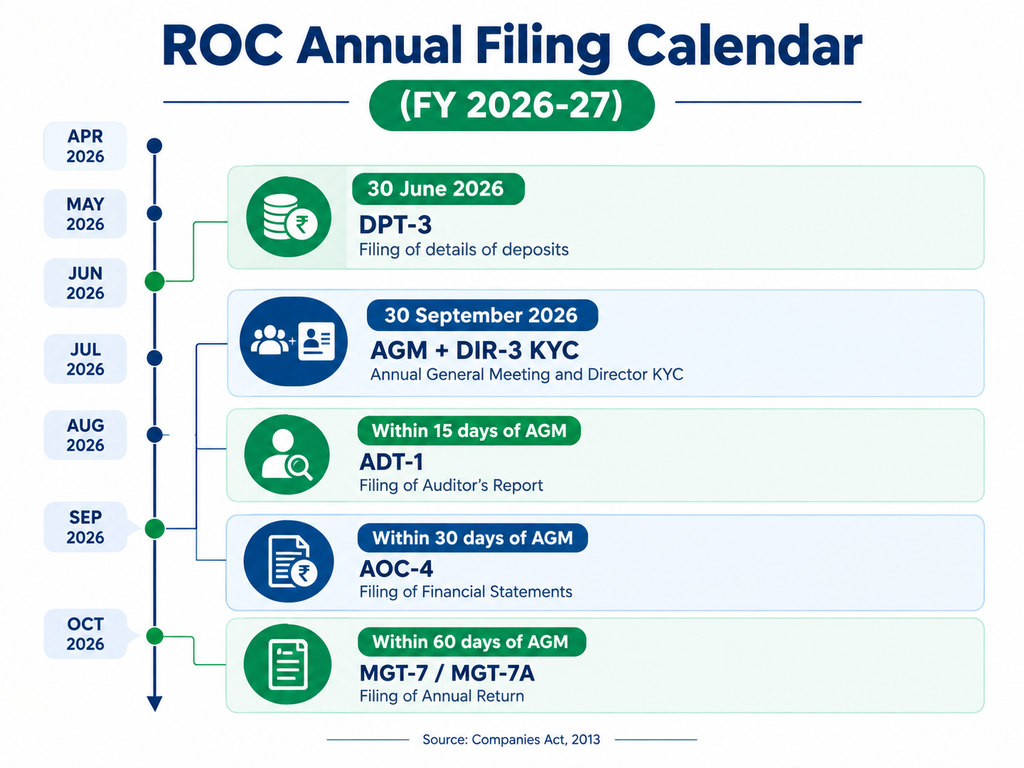
The Annual Filing Calendar (FY 2026-27)
| Form | Purpose | Due Date |
|---|---|---|
| DPT-3 | Return of deposits/loans | 30 June 2026 |
| AGM | Annual General Meeting | By 30 September 2026 |
| ADT-1 | Auditor appointment | Within 15 days of AGM |
| AOC-4 | Financial statements | Within 30 days of AGM |
| MGT-7/MGT-7A | Annual return | Within 60 days of AGM |
| DIR-3 KYC | Director KYC | 30 September 2026 |
Penalties for Late Filing: ₹100 Per Day, No Cap
This is where things get serious.
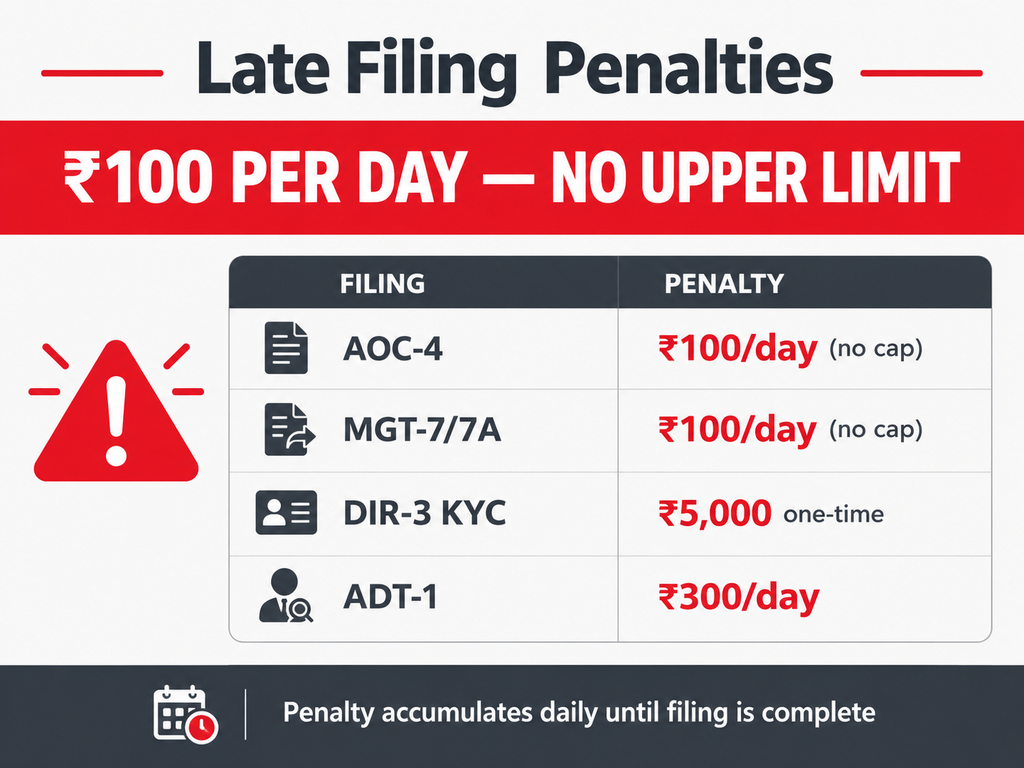
Under Section 403 of the Companies Act, 2013, an additional fee of ₹100 per day applies for delay in filing annual returns and financial statements — with no upper limit. The meter starts ticking from the day after the due date and runs until the date of actual filing.
Form-wise penalty reference:
| Form | Late Penalty | Maximum |
|---|---|---|
| AOC-4 | ₹100 per day | No cap — accumulates indefinitely |
| MGT-7 / MGT-7A | ₹100 per day | No cap — accumulates indefinitely |
| ADT-1 | ₹300 per day | Auditor appointment intimation |
| DIR-3 KYC | ₹5,000 one-time | DIN deactivated until paid |
| MGT-14 | ₹100 per day | Resolutions — no cap |
| DIR-12 | ₹100 per day | Director changes — no cap |
| PAS-3 | ₹100 per day | Share allotment — no cap |
| DPT-3 | ₹5,000 + ₹500/day | Continuing violation |
Beyond Late Fees: The Real Consequences
The ₹100 per day penalty is just the beginning. Non-compliance triggers a cascade of consequences that can end a company’s legal existence.
Director Disqualification
Under Section 164(2), a director of a company that has not filed financial statements or annual returns for 3 consecutive financial years is disqualified from being a director in any company for 5 years. This disqualification follows the individual — not just the company.
Company Strike-Off
The ROC can strike off a company under Section 248 after it fails to file for 2 consecutive years. A struck-off company loses its legal status and CIN. Restoration is expensive and time-consuming.
Bank Account and Funding Problems
Banks run compliance checks before approving credit facilities or overdrafts. A company with ROC filing defaults may have its credit applications rejected or existing facilities withdrawn.
Investors and VCs check MCA filings during due diligence. Filing gaps are major red flags that can kill a funding round.
Government tenders often require statutory filings to be current. A non-compliant company may be ineligible to bid.
Real Penalty Orders: What Companies Actually Pay
Adjudication orders from ROC offices show the real cost of delay.
In one case, a company filed its MGT-7 for FY 2022-23 with a delay of 245 days. The penalty imposed was ₹34,500 each on the company and its four directors.
In another case, a company that failed to file its annual return for FY 2023-24 faced penalties on the company and nine officers — with individual penalties ranging from ₹13,500 to ₹50,000.
These are not hypothetical numbers. They are being levied.
The CCFS-2026: A One-Time Relief Window
For companies that have accumulated significant delays, the MCA introduced the Companies Compliance Facilitation Scheme, 2026 (CCFS-2026) — a one-time opportunity to regularise pending filings at drastically reduced costs.
Scheme period: 15 April 2026 to 15 July 2026.
Key benefits:
- 90% relief on additional fees: Companies pay the normal filing fee plus only 10% of the additional fee that would otherwise be due.
- Immunity from penalties: No penalty will be levied on defaulting companies if annual returns and financial statements are filed under the Scheme before, or within 30 days of, issuance of notice by the adjudicating officer.
- Dormancy option: Inactive companies can apply for dormant status by paying 50% of the normal filing fee.
- Strike-off option: Companies intending to close can file for strike-off by paying 25% of the applicable filing fee.
Forms covered: MGT-7, MGT-7A, AOC-4 and its variants, ADT-1, FC-3, FC-4, and certain forms under the erstwhile Companies Act, 1956.
Eligibility exclusions: Companies already facing final strike-off notices, those that have already applied for strike-off or dormancy, dissolved entities, and vanishing companies are not eligible.
Important: This is a one-time opportunity. Upon conclusion of the Scheme, ROCs will take necessary action against companies that remain in default.
Who Is Responsible?
ROC compliance is a legal obligation of the company and its directors — not just of the CA or CS managing the filings.
- Board of Directors: Collectively responsible for ensuring all statutory filings are made on time. Non-compliant directors can be personally penalised and disqualified.
- Managing Director / Whole-Time Director: Primary officer responsible for operational compliance.
- Company Secretary: Where appointed, prepares, reviews, and files all ROC forms.
- Statutory Auditor: Responsible for completing and signing the audit report in time for AOC-4 filing.
Best Practices to Avoid Penalties
- Create a compliance calendar with all ROC deadlines specific to your company’s financial year and incorporation date.
- Start early — begin gathering financial statements, audit reports, and board minutes well before deadlines.
- Verify accuracy — check that all data in the forms matches the signed financial statements and board resolutions.
- Use digital record-keeping — maintain organised copies of all past filings for quick access.
- Seek professional help — work with qualified Company Secretaries or Chartered Accountants.
- Conduct internal audits periodically to spot and fix issues before they become compliance defaults.
Final Word
ROC compliance is not a formality. It is the foundation of a company’s legal standing. The ₹100 per day penalty has no cap, and it accumulates silently until the bill becomes enormous.
For companies that are behind, the CCFS-2026 offers a rare lifeline — but the window closes on 15 July 2026. For companies that are current, the message is simple: stay on top of your deadlines. One missed filing can start a chain of consequences that are far more expensive than the filing fee itself.
Disclaimer: This blog is for informational purposes only. It is not legal or professional advice. ROC compliance requirements and penalties are governed by the Companies Act, 2013 and MCA notifications. Please consult a qualified Company Secretary or Chartered Accountant for guidance specific to your company.