
Starting your first SIP can feel overwhelming with thousands of mutual fund schemes available in India. But here’s the truth: the fund you choose matters less than the habits you build. A disciplined SIP in a “boring” diversified fund often beats a confused investor chasing “hot” funds
Let me break down what you actually need to check before putting your money in any mutual fund
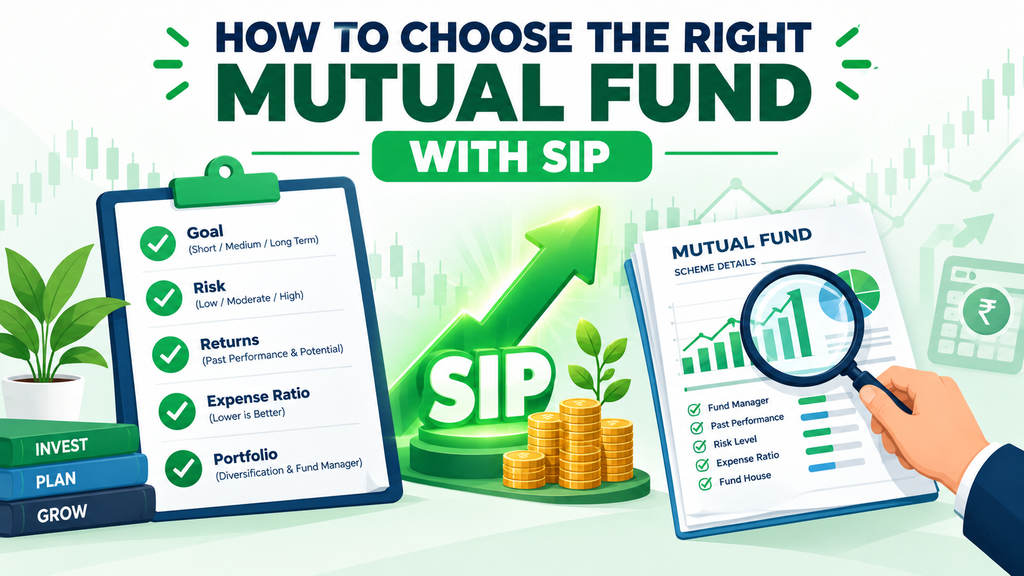
Step 1: Define Your Goal and Time Horizon
Before looking at a single fund, answer this: Why am I investing?
- Retirement (10+ years): Equity funds work best
- Child’s education (7-10 years): Hybrid or flexi-cap funds
- House down payment (3-5 years): Debt or hybrid funds
- Emergency fund (1-2 years): Liquid funds
Your time horizon determines your risk capacity. Short-term goals need stability; long-term goals can handle equity volatility
Step 2: Know Your Risk Appetite
SEBI’s Riskometer provides a standardized way to understand fund risk. Every scheme has one, ranging from “Low” to “Very High”
Ask yourself honestly:
- If my ₹1 lakh investment drops to ₹75,000 in a market crash, will I panic and sell?
- Or will I keep investing because my goal is 10 years away?
SIP does not make a risky fund safe. It only averages your purchase cost. If the fund is unsuitable, SIP won’t fix that
Step 3: Choose the Right Fund Category
For first-time investors, the experts recommend starting simple
| Fund Type | Best For | Why |
|---|---|---|
| Flexi Cap Fund | Most beginners | Manager can move across large/mid/small caps |
| Large Cap Fund | Conservative investors | Invests in top 100 companies, more stable |
| Index Fund | Low-cost seekers | Tracks Nifty 50, no fund manager risk |
| Aggressive Hybrid | Nervous investors | Mix of equity + debt, smoother ride |
Avoid sectoral or thematic funds when starting. These are concentrated, volatile, and often perform best after the rally has already happened .
Step 4: Check the Fund’s Track Record (Properly)
Don’t just look at 1-year returns. That’s yesterday’s news.
Look for:
- 5-7 year performance: Has it survived different market cycles?
- Rolling returns consistency: What percentage of 3-year periods has it beaten its benchmark?
- Performance vs category average: Is it actually better than similar funds?
A fund that delivered 159% in 5 years might have had a terrifying 40% drawdown in between. Check how it behaved during market corrections
Step 5: Understand the Costs
Expense Ratio is the annual fee the fund charges. Even 1% difference compounds significantly over 20 years.
| Plan Type | Typical Expense Ratio | Who Should Choose |
|---|---|---|
| Direct Plan | 0.5% – 1.2% | DIY investors |
| Regular Plan | 1.2% – 2.2% | Those wanting advisor support |
If you invest ₹1 lakh, a 1% expense ratio costs ₹1,000/year. A 0.5% ratio costs ₹500. Over 20 years, that small difference becomes massive

Step 6: Look Inside the Portfolio
Two funds can have the same name but completely different holdings.
Check:
- Top 10 holdings concentration: Is it too dependent on a few stocks?
- Sector allocation: Is it diversified or betting heavily on one sector?
- Portfolio overlap: If you own multiple funds, do they hold the same stocks? High overlap means you’re paying extra fees for the same result
Step 7: Evaluate the Fund Manager
The person managing your money matters.
Look for:
- Tenure: How long have they managed this fund?
- Consistency: Has their style remained stable across market cycles?
- Experience: Have they managed money through a bear market?
Step 8: Check Exit Load and Tax
Exit Load: Some funds charge 1% if you withdraw within 1 year. Check before investing .
Taxation:
- Equity funds: 12.5% LTCG tax on gains above ₹1.25 lakh (if held >1 year)
- Debt funds: Taxed as per your income slab, regardless of holding period
The Simple Rule for Beginners
Start with 1-2 funds. Not 7.
A beginner with a flexi-cap fund and a debt fund can build significant wealth over 10 years. A beginner with 7 sectoral funds will likely panic and exit during the first market crash .
Ask yourself: “If this fund falls 30%, will I keep investing?” If the answer is no, choose a more stable fund.
Quick Checklist Before You Invest
- □ Goal defined (retirement, education, house)
- □ Time horizon clear (3 years? 10 years?)
- □ Risk appetite honestly assessed
- □ Fund category matches goal and risk
- □ 5-year track record checked
- □ Expense ratio compared with peers
- □ Portfolio holdings reviewed
- □ Fund manager tenure checked
- □ Exit load understood
- □ SIP amount sustainable within budget
Conclusion
Choosing your first mutual fund is not about finding the “best” fund. It’s about finding a fund you can stick with through market ups and downs.
The best fund for you is the one that matches your goal, fits your risk comfort, and doesn’t stress you out when markets fall. Start simple. Stay consistent. Let compounding do the work.
Disclaimer: This content is for informational purposes only. Mutual fund investments are subject to market risks. Please consult a SEBI-registered financial advisor before investing.