

Most beginners hit a wall the moment they encounter Debit (Dr) and Credit (Cr).
Why does receiving cash mean “Debit”, while receiving goods from a supplier means “Credit”? Why does the meaning seem to change from one situation to another?
The secret is simple: Debit and Credit do not mean “good” and “bad”, or “profit” and “loss”. They are simply directional tools in the double-entry bookkeeping system.
In this beginner-friendly guide, we break down the Golden Rules of Accounting with clear, real-life examples so you never mix up Dr and Cr again

Quick Summary: The Golden Rules Cheat Sheet
Save or bookmark this table—it covers 90% of what you need to know:
| Account Type | What It Represents | The Golden Rule | Quick Example |
| Real Account | Assets & Properties (Cash, Stock, Furniture) | Debit what comes in, Credit what goes out | Bought machinery for cash: Machinery (Dr), Cash (Cr) |
| Personal Account | People, Businesses, Banks (Rahul, ABC Ltd, HDFC) | Debit the receiver, Credit the giver | Paid Mohan ₹5,000: Mohan (Dr), Cash (Cr) |
| Nominal Account | Expenses, Losses, Incomes, Gains | Debit all expenses & losses, Credit all incomes & gains | Paid shop rent: Rent (Dr), Cash (Cr) |
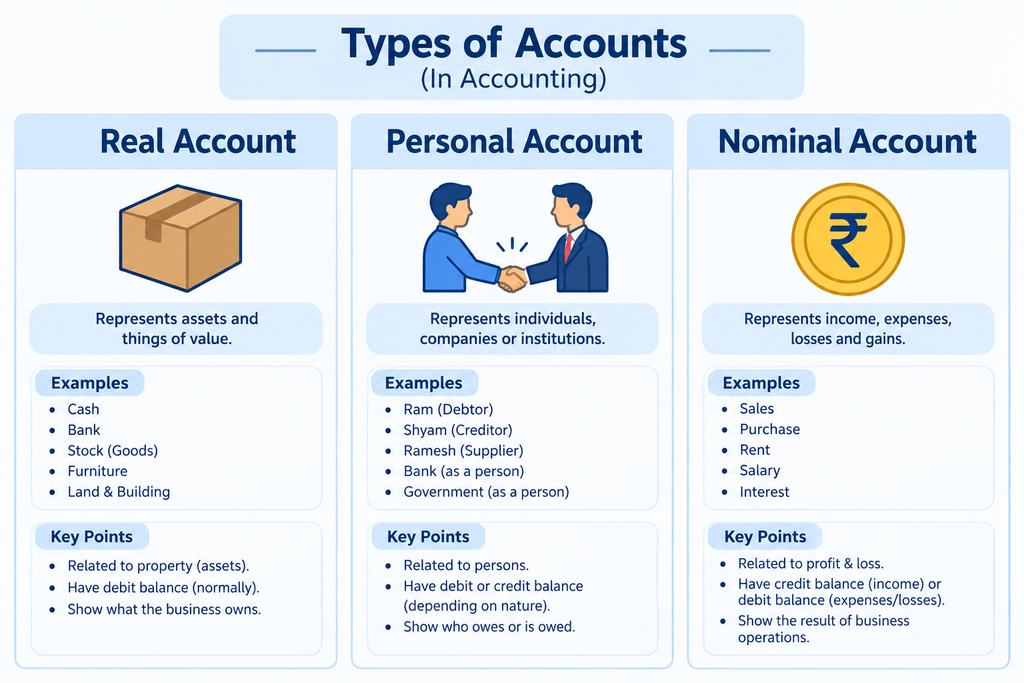
Step 1: Understand the 3 Types of Accounts
Before applying any rule, you must identify what kind of account you are dealing with. Every transaction involves at least two of these:
1. Real Accounts (Assets)
Real accounts deal with physical and tangible things your business owns, as well as measurable intangible assets:
- Examples: Cash, Inventory (Stock), Furniture, Machinery, Building, Patents, Goodwill.
2. Personal Accounts (Entities)
Personal accounts represent the individuals, firms, suppliers, customers, and banks you interact with:
- Natural persons: Ramesh, Priya.
- Artificial legal entities: ABC Corp, Tata Ltd, HDFC Bank.
- Representative accounts: Owner’s Capital Account, Drawings Account, Outstanding Salaries.
3. Nominal Accounts (Revenue & Expenses)
Nominal accounts do not hold physical assets. They track income, gains, expenses, and losses for a financial year:
- Expenses & Losses: Shop rent, staff salaries, electricity bills, discount allowed, loss by fire.
- Incomes & Gains: Sales revenue, interest received, commission earned, discount received.
Step 2: The Three Golden Rules Explained with a Real-Life Example
Let’s understand these rules through a small Shoe Store called StepRight Shoes.
[Transaction Occurs]
       │
       ├── Which accounts are involved?
       ├── What type are they? (Real, Personal, or Nominal?)
       └── Apply the corresponding Golden Rule!
Rule 1: Real Accounts
“Debit what comes in, Credit what goes out.”
Whenever an asset enters the business, you Debit it. Whenever an asset leaves the business, you Credit it.
- Example: The store buys new inventory (shoes) worth ₹10,000 by paying cash.
- Shoes/Stock is coming into the shop
→→Debit Inventory/Purchases Account. - Cash is going out of the cash register
→→Credit Cash Account.
- Shoes/Stock is coming into the shop
Rule 2: Personal Accounts
“Debit the receiver, Credit the giver.”
When dealing with a person, vendor, or bank:
- If that person is receiving money or value from your business
→→Debit their account. - If that person is giving money, goods, or value to your business
→→Credit their account. - Example A (The Giver): The store buys ₹20,000 worth of shoes on credit from a supplier named Apex Footwear.
- Apex Footwear is giving goods on credit
→→Credit Apex Footwear Account. - (Stock is coming in
→→Debit Purchases Account).
- Apex Footwear is giving goods on credit
- Example B (The Receiver): Two weeks later, the store pays ₹20,000 cash to Apex Footwear to settle the bill.
- Apex Footwear is the receiver of the payment
→→Debit Apex Footwear Account. - Cash is going out
→→Credit Cash Account.
- Apex Footwear is the receiver of the payment
Rule 3: Nominal Accounts
“Debit all expenses and losses, Credit all incomes and gains.”
Money spent to keep the business running is an expense (Debit). Money earned through your business activities is revenue or gain (Credit).
- Example A (Expense): The store pays ₹15,000 monthly rent via bank transfer.
- Rent is a business expense
→→Debit Rent Account. - Bank is giving the funds
→→Credit Bank Account.
- Rent is a business expense
- Example B (Gain): The store receives ₹500 as a cash discount from a supplier.
- Discount received is a financial gain
→→Credit Discount Received Account.
- Discount received is a financial gain
How It Looks in an Actual Journal Entry
In double-entry bookkeeping, total debits must always equal total credits. Here is how standard transactions look in a formal journal:
Oct 01
Rent A/c Dr. — ₹5,000
To Cash A/c — ₹5,000
Reason: Rent is an expense (Nominal: Dr), Cash goes out (Real: Cr)
Oct 05
Cash A/c Dr. — ₹12,000
To Sales A/c — ₹12,000
Reason: Cash comes in (Real: Dr), Sales is income (Nominal: Cr)
Oct 10
Drawings A/c Dr. — ₹2,000
To Bank A/c — ₹2,000
Reason: Owner is receiver for personal use (Personal: Dr), Bank is giving money (Personal: Cr)

Bonus: The Modern Approach (The “DEALER” Rule)
While the traditional Golden Rules are widely used in India and the UK, modern international accounting uses the Accounting Equation approach. Many beginners find this even easier to remember!
Just remember the acronym D-E-A-L-E-R:
DEBIT TO INCREASE                    CREDIT TO INCREASE
─────────────────                    ──────────────────
D - Dividends / Drawings             L - Liabilities
E - Expenses                         E - Equity / Capital
A - Assets R - Revenue- To increase an Asset or Expense: Debit it.
- To increase a Liability, Capital, or Revenue: Credit it.
- (The reverse decreases them: credit decreases an asset, debit decreases a liability).
4 Costly Mistakes Beginners Should Avoid
- Thinking Debit means “money in bank”: Your bank statement calls deposits “credit” because from the bank’s perspective, your money is a liability they owe back to you. In your own business books, cash in bank is an asset and a debit balance.
- Writing person names during cash purchases: If you buy goods for instant cash, do not record the supplier’s name. Use Purchases A/c Dr to Cash A/c. Personal names are only tracked for credit transactions.
- Confusing Personal Expenses with Business Expenses: Withdrawing money from the business for personal or family use is Drawings, not regular business expense.
- Trying to memorize without identifying the account: Don’t guess. Always ask two questions: “Which two accounts are involved?” and “Are they Real, Personal, or Nominal?”
Test Your Knowledge (Quick 60-Second Quiz)
Try passing the entries for these transactions before checking your answers:
- Paid electricity bill ₹1,200 in cash.
- Answer: Electricity Expense A/c (Dr) | Cash A/c (Cr)
- Deposited ₹10,000 cash into the company bank account.
- Answer: Bank A/c (Dr — receiver) | Cash A/c (Cr — goes out)
- Purchased office computer for ₹35,000 on credit from TechMart.
- Answer: Computer/Equipment A/c (Dr — asset comes in) | TechMart A/c (Cr — giver)
Frequently Asked Questions (FAQ)
Q1: What does “Dr” and “Cr” stand for?
“Dr” stands for Debere (Latin for “to owe”) or Debit Record. “Cr” stands for Credere (Latin for “to entrust/believe”) or Credit Record.
Q2: Why does every transaction have both a debit and a credit?
This is the foundation of Double-Entry Bookkeeping. Every business transaction is an exchange: something comes in and something goes out, or one party gives while another receives. Debits must equal Credits to keep the balance sheet in equilibrium.
Q3: Is Cash always a Debit?
No. When cash enters your business, it is debited (What comes in). When your business spends cash, it is credited (What goes out).
Q4: Which is better: Golden Rules or the Modern DEALER Rule?
Both yield the exact same journal entries! Traditional Golden Rules are great for grasping the physical flow of transactions, while the Modern (DEALER) approach makes financial statement preparation much simpler.
Need Help Mastering Bookkeeping?
Drop your questions in the comments below, and our accounting mentors will help you break down any confusing transaction!